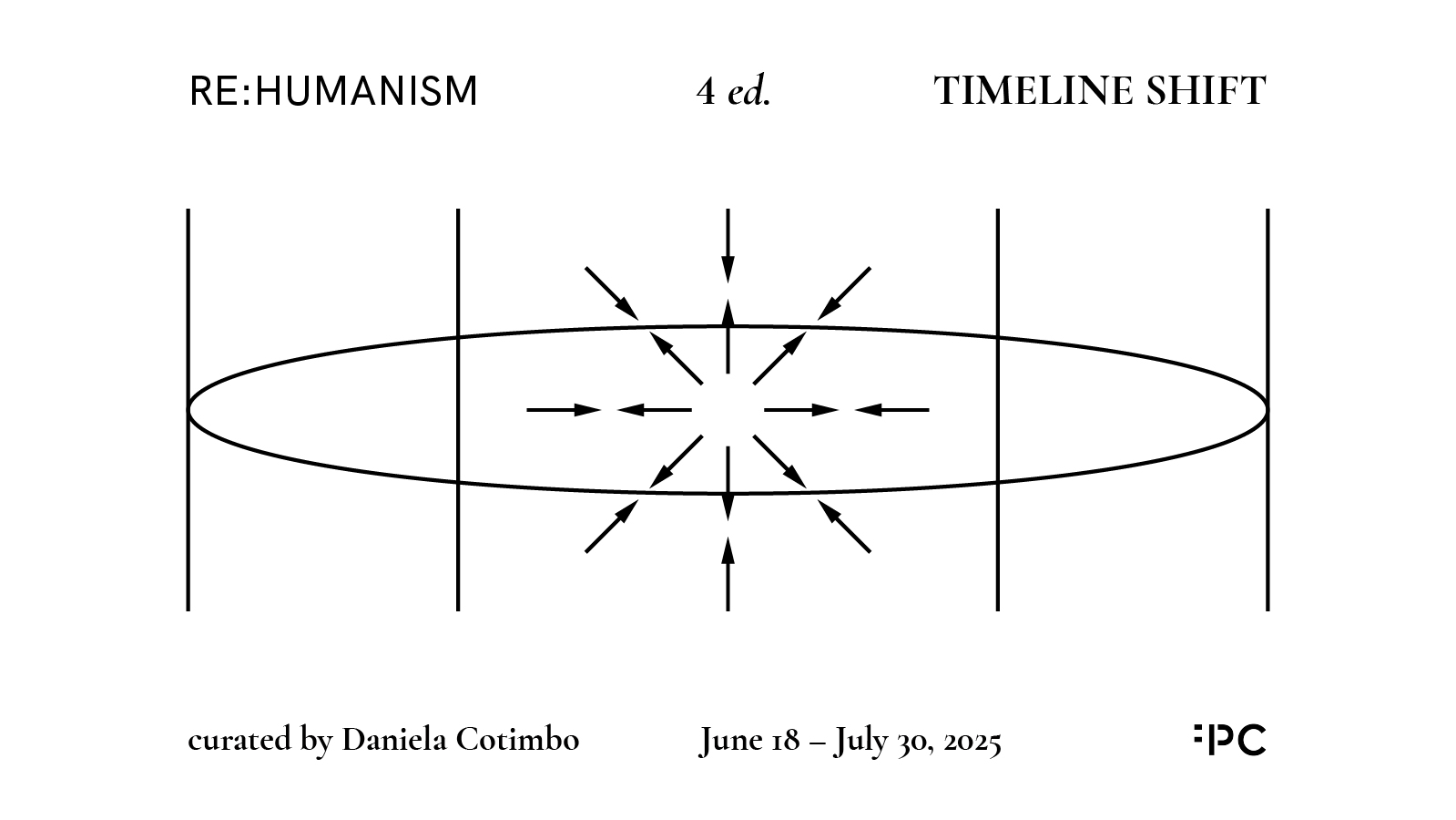
The 4th edition of the Re:humanism Art Prize, entitled Timeline Shift, literally – “displacement of the temporal sequence” – aims to question the extractive logics of data and resource exploitation that currently drive AI development, paving the way for more ethical, sustainable, and inclusive technological models. The works offer speculative, poetic, and political perspectives that deconstruct dominant value systems and open up new horizons of thought.
On view will be the works of the ten finalists. Also featured is the winner of the APA Prize, whose work will be displayed on APA’s digital advertising screens throughout the city of Rome for the entire duration of the exhibition.
Through a deep reflection on artificial intelligence, the exhibited projects challenge the Western conception of time, as linear, progressive, and productivity-oriented, offering instead a plural, synchronic, and ritualistic reinterpretation.
The works offer speculative, poetic, and political perspectives that deconstruct dominant value systems and open up new horizons of thought.
The Re:humanism Art Prize thus reaffirms itself as a space for research and critical vision, where the dialogue between art and artificial intelligence fosters awareness, transformation, and imagination about the future.
The first prize in the MAIN PRIZE category was awarded to the collective Lo-Def Film Factory, composed of François Knoetze and Amy Louise Wilson, for Concept Drift, an immersive and interactive environment that weaves together video game aesthetics, visual archives, and postcolonial storytelling.
The second prize went to Isabel Merchante for One Day I Saw the Sunset Ten Thousand Times, a poetic meditation on the mechanization of perception and the digital reproducibility of nature. Third prize was awarded to Minne Atairu for Da Braidr, a “conceptual startup” that employs AI to empower the micro-entrepreneurial economy of Afro hair braiding, while deconstructing AI’s promotional rhetoric within technocapitalist discourse.
Among the other seven finalists:
Federica Di Pietrantonio, a returning finalist, presents Net Runner 01, a “wearable” installation that investigates how virtual environments shape our perceptions of identity, time, and relationships. Inspired by motion photography pioneer Eadweard Muybridge, Me vs. You is a multi-channel video installation by Adam Cole and Gregor Petrikovič that delves into the nuances of queer intimacy in a world increasingly mediated by AI. Using wrestling sequences, the work exploits AI vision’s inability to distinguish entangled bodies, questioning computational systems of classification and control, turning AI into a tool of poetic ambiguity.
In Ever Amanda E. Metzger presents a generative, decentralized diary archive powered by an AI trained on her personal writings collected from 2010 to 2023.
Esther Hunziker’s Screen Tests comprises AI-generated video portraits, reminiscent of both cinematic casting photos and Andy Warhol’s screen tests, where human figures blend with furry entities. The Pit by Daniel Shanken is an immersive installation that evokes the natural erosion and industrial landscapes of rare earth extraction, the backbone of AI infrastructures, dragging the viewer into the unstable threshold between technological enchantment and systemic collapse. AI-Ludd, a video installation by the collective IO COSE, stages a fictional AI trained to think and act like a Luddite. Finally, Cloud Scripts by Kian Penk Ong interprets Taoist Cloud Seals as an asemic form of communication with the spiritual world.
The APA Prize was awarded to Franz Rosati for DATALAKE:CONTINGENCY, a project that presents constantly shifting AI-generated scenarios, exploring the tension between nature and technology and their attempted coexistence.
During the official opening, two additional installations by students of the RUFA – Rome University of Fine Arts MFA in Multimedia Arts & Design will also be presented at RUFA Space, adjacent to Fondazione Pastificio Cerere.
An audio-visual performance by Franz Rosati will also take place in the courtyard of the foundation on the same evening.
Lastly, the Digitalive Prize of Romaeuropa Festival was awarded to Valerie Tameu for Metabolo II: Orynthia, a performance exploring the relationship between AI, natural ecosystems, and cultural traditions through a decolonial and post-anthropocentric lens.
As in the previous edition, a special mention of the Digitalive Prize was awarded to Jessica Tucker for her project Improbable Excess, a performance combining prints, videos, and interactive digital renderings of mutant bodies. The work exposes how algorithmic gazes pursue, decode, reduce, and reconstruct us, manipulating our desire for certainty and control.
Both projects will be presented in September at Mattatoio in Rome as part of the festival’s official program.
The exhibition will be open until July 30 2025.
Project partners: Fondazione Pastificio Cerere, Fondazione Romaeuropa, APA
Main sponsors: Alan Advantage, Frontiere, Translated
Supporters: Eit Digital, Seeweb
Other Partners: Rufa – Rome University of Fine Arts
CONTACTS
+39 06 45422960 | info@pastificiocerere.it | press@pastificiocerere.it
www.pastificiocerere.it
Social Media Manager: UC studio – press@ucstudio.it
info@re-humanism.com I www.re-humanism.com
INFORMATIONS
Opening: 18 giugno 2025 dalle 18.00 alle 21.00
Date: dal 19 giugno al 30 luglio 2025
Opening hours: from Monday to Friday from 3.00 pm to 7.00 pm;
Location: Fondazione Pastificio Cerere, Via degli Ausoni 7 – Roma
Info: Tel. +39 06 45422960 | info@pastificiocerere.it | www.pastificiocerere.it
PRESS CONTACTS
GDG Press
Ludovica Solari | + 39 335 5771737 | press@ludovicasolari.com
Alessandro Gambino | +39 320 8366055 | alessandro@gdgpress.com